Why We Keep Hoping: Living Human Lives in Systems Not Built for Humans
A reflective essay on human hope, political systems, and why people continue to believe in a better future, even when the structures around us were never built for human life.
REIMAGINE LIFEPEACENEW SOCIETYANXIETYPRESCENCEREIMAGINE SOCIETYHEALINGCOMPASSION
Verdandi Weaver
1/22/20262 min read
Sometimes it just becomes unbearably sad.
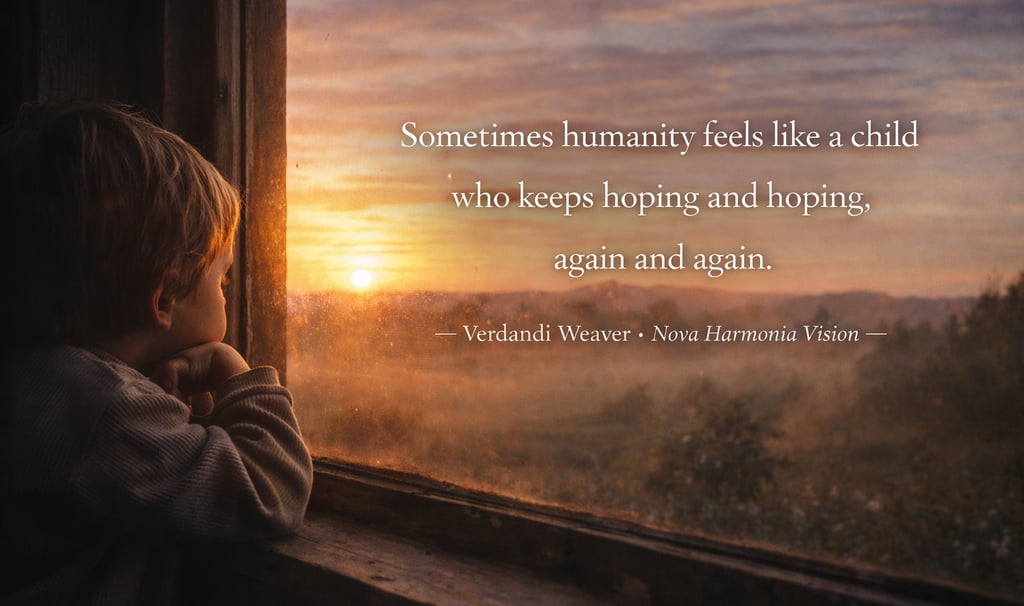
When I look at humanity as a whole, it feels like watching an orphaned child sitting by a window, hoping to be given a family. Hoping to be chosen. Hoping to be held.
As adults, we do something similar.
Every four years, we cast our vote and hope:
This time it will be better.
This time they are the right politicians.
This time healthcare will improve.
This time we won’t have to struggle so hard.
And every time there are beautiful words.
But when decisions are made, it is the systems that carry the most weight.
GDP. Markets. Stability for those who are already wealthy. Borders. Threats—not to us as people, but to those in power.
Not beautiful words meant for us, for people in general.
And every time, ordinary people are left sitting with their shattered hopes, waiting—patiently—for another four years.
The most beautiful and, at the same time, the saddest thing about us humans is that we keep trying.
We do everything we can to improve our situation, no matter how hard it is.
We adapt, we struggle, we hold things together, we take responsibility.
Even though the people always outnumber those in power, humans are fundamentally peaceful.
They are not violent. Not war-driven. They do not want to burn the world down.
They want to live.
To take care of their children.
To receive care when their bodies break down.
To stop being afraid all the time.
That is why we keep hoping.
Not because we believe in the systems—but because we believe in life.
Because we keep placing our hope in another human being’s hands.
We think it is just a piece of paper with a cross on it,
but in reality, it is hope for a better life that lands in the ballot box.
And we don’t even fully realize it.
And yes, that is both the most beautiful and the most heartbreaking thing about humanity.
Because it becomes clear that it is not even the politicians who can truly change this. No matter who is elected, they must operate within systems that were never built for human lives, human bodies, or human vulnerability.
We place our hope in something that cannot carry it. And we know it.
Still, we continue.
We try again.
And again.
And again.
Not because we are weak, but because we are relational beings.
Because we long for safety, for belonging, for someone to respond.
We bend so much that we begin to disappear.
We grow tired.
Numb.
Silent.
One generation at a time.
That is what is heartbreaking.
Not that hope exists.
But that hope exists, despite how rarely it is met.
And politicians do not hold what they are given as the precious thing it truly is:
the hope of thousands, millions—countless human beings—in their hands.
This is a deep grief.
A grief that comes from deep love.
And from having felt how much hope people actually carry.
And just as no child should ever have to be orphaned—
because in another world there is enough care, time, and shared energy to raise every child together—
we should not have to live our lives in constant waiting.
We should not have to keep hoping and bending, over and over again,
until we eventually disappear,
simply because the systems we live in were not built for us.
A world that can carry children can also carry people.
What is missing is not willingness.
What is missing are structures built for life.
contact@novaharmonia.world
© 2025. Nova Harmonia. All rights reserved.
"We are the dreamers of dreams, the weavers of worlds yet to come."
Nova Harmonia
Embracing new paradigms of unity, and the co-creation of a harmonious world.
Contact
Connect
Quick Links
Privacy Policy